Resistance management of potato late blight

Managing resistance within Phytophthora infestans populations is now a key challenge for potato protection in Europe. EuroBlight data show that the pathogen’s genetic structure is evolving rapidly, with the periodic emergence of dominant genotypes and variants with reduced sensitivity. Combined with the decreasing number of active substances available in Europe, this dynamic increases the vulnerability of programmes relying on a limited number of modes of action.
In this context, understanding the mechanisms driving adaptation—gene flow, progressive genotype replacement, and selection pressure associated with single‑site fungicides—is essential for building more durable strategies. European growers, aiming to secure yield stability despite this evolutionary variability, are increasingly integrating complementary tools such as OPSeed75 to reduce pressure on sensitive modes of action and reinforce programme robustness within an IPM (Integrated Pest Management) approach.
*EuroBlight – European expert network focused on sustainable management of potato late blight and early blight
What is “resistance” to plant protection products?
According to R4P*, which brings together specialists from INRAE and ANSES, resistance is defined as a reduction in a pest’s sensitivity to a plant protection product. It develops when a few individuals, naturally less sensitive, survive an application that would normally control the majority of the population. Over successive cycles, these individuals multiply and transmit resistance traits, progressively reducing product efficacy.
Resistance is a selection process: mutations or less‑sensitive variants already exist within the population, and repeated applications select for them until the product no longer provides reliable control.
*R4P – Réseau de Réflexion et de Recherche sur la Résistance aux Pesticides (French network for reflection and research on pesticide resistance)
Resistance mechanisms in late blight
Le mildiou (Phytophthora infestans)can adapt very quickly to fungicides. According to ARVALIS*, two main types of resistance exist in fungi:
- Target‑site resistance (TSR) – the most common mechanism in late blight:
The pathogen modifies the site where the fungicide normally acts, reducing product efficacy.
Because this modification is often caused by a single mutation, the risk of resistant strains increases significantly when the same mode of action is used too frequently. Cross‑resistance may also occur between related products. - Non‑target‑site resistance (NTSR):
The pathogen does not alter the action site but develops alternative mechanisms to bypass the product (e.g., faster active‑ingredient efflux). This mechanism exists but appears less significant in late blight than TSR.
*ARVALIS – French technical institute that conducts field trials to provide objective data on varieties, crop practices and plant protection
Strains moving between regions
Late blight strains do not remain confined to a single location: they move between regions, farms and cropping systems (via wind, seed tubers, machinery, or rotation patterns).
According to EuroBlight’s European monitoring, this circulation:
- Facilitates the rapid introduction of new resistant strains,
- Accelerates the replacement of sensitive strains,
- Promotes the establishment of more difficult‑to‑control variants.
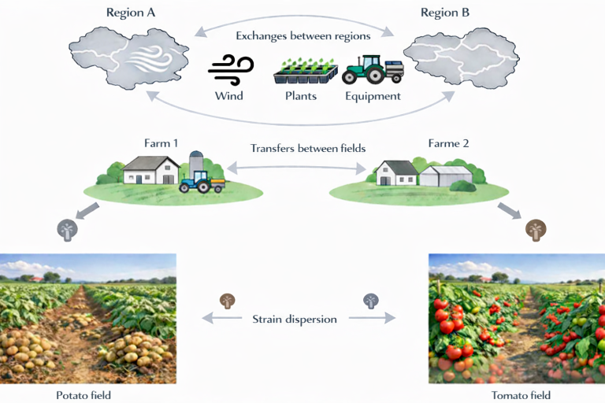
Circulation of late blight strains
In this context, diversifying control tools—especially with solutions that do not exert selection pressure, such as OPSeed75—helps maintain programme durability.
Why late blight evolves and adapts so quickly?
Potato late blight, caused by Phytophthora infestans, has an exceptional evolutionary potential. It exhibits high genetic variability, rapid generational turnover, and a strong capacity to colonise new tissues. Under wet conditions, the infection cycle can renew within a few days, mechanically increasing opportunities for mutation.
Repeated applications of the same fungicide intensify selection pressure: naturally less‑sensitive genotypes persist, reproduce, and eventually dominate the population. This evolutionary process, comparable to the development of antibiotic resistance in bacteria, leads to fungicide resistance.
Across Europe, the EuroBlight network carries out structured monitoring of Phytophthora infestans, genotypes, documenting the emergence of reduced‑sensitivity variants and their spatial and temporal dynamics. These reference data are essential for adapting late blight management strategies sustainably.
Agronomic consequences of established resistance
Established resistance may cause:
- Reduced efficacy of applied fungicides,
- More frequent applications to maintain adequate protection,
- Higher risk of rapid outbreaks even with regular programmes,
- Reduced flexibility when designing strategies,
- Direct impacts on yield and crop quality.
Why current fungicide programmes need to evolve
With the gradual withdrawal of many active substances, integrated protection programmes must rely on an increasingly limited number of tools. According to the European Parliament, the exclusion and substitution criteria under Regulation (EC) No 1107/2009 have led to a continuous reduction in the number of authorised active substances, increasing dependence on a few key modes of action and raising the risk of selecting less‑sensitive populations (European Parliamentary Research Service, “The EU’s reduced availability of plant protection active substances”, 2018).
In light of this, diversifying agronomic levers and adopting preventive strategies are essential to maintain long‑term efficacy in late blight management.
In practice, this shift results in:
- More complex rotation of modes of action due to a limited range of usable chemical families,
- Increased pressure on remaining molecules, which must cover more situations and crop stages,
- The need to integrate complementary tools, particularly multisite solutions such as OPSeed75, to diversify strategies and reduce dependence on conventional fungicides.
Agronomic strategies to limit resistance development
Before any fungicide applications, the first line of defence lies in agronomic practices. By reducing inoculum and making the crop environment less favourable to late blight, these practices lower initial pressure and help reduce reliance on fungicides. This reduction in exposure indirectly limits selection pressure, especially on single‑site fungicides.
Key conditions for a sustainable agronomic foundation:
- Use certified seed tubers,
- Eliminate volunteers and infected residues,
- Employ crop rotation to reduce inoculum sources,
- Apply irrigation carefully to limit leaf wetness,
- Improve canopy aeration through adapted planting densities.
Rational management of late blight treatments
Fungicide efficacy and durability rely on reducing selection pressure: diversifying modes of action and treating only when justified by the risk.
Modes of action:
- Alternate chemical families,
- Combine single‑site fungicides with products with a different mode of action whenever possible,
- Avoid repeated use of the same mode of action,
- Adjust dose rates based on risk level.
Positioning:
- Intervene preventively,
- Rely on weather data and decision support tools,
- Optimise spray quality,
- Limit curative applications.
Why integrate complementary solutions alongside conventional fungicides?
With fewer active substances available and a pathogen capable of evolving rapidly, complementary solutions have become essential for reinforcing long‑term programme sustainability. Their integration helps diversify control tools, reduce pressure on key fungicides, and enhance overall programme robustness.
These solutions contribute significantly to integrated crop protection by:
- Diversifying modes of action,
- Reducing dependence on synthetic fungicides,
- Lowering selection pressure.
Basic substances and biocontrols: a strategic role
Because they act through multiple mechanisms, these solutions present a low risk of resistance development and fit well within durable strategies compatible with organic farming.
OPSeed75: integrating a basic substance into late blight management
OPSeed75 is a basic substance derived from grape seeds, authorised at the EU level under Regulation (EC) No 1107/2009. Its naturally high content of procyanidolic oligomers (OPCs) makes it well‑suited to integrated protection approaches.
By acting directly on the pathogen and stimulating natural plant defences, OPSeed75 presents a low risk of resistance development in Phytophthora infestans.
Role within late blight programmes:
- Reduce repeated use of single‑site fungicides,
- Diversify modes of action,
- Support preventive approaches within integrated plant protection.
Its benefits come not only from direct action but also from the diversification of control levers, which strengthens programme robustness and durability.
Building a sustainable programme: key takeaways
Resistance management relies on a well‑balanced combination of levers: agronomy, genetics, rotation of modes of action, and the integration of solutions such as OPSeed75. The more diverse and anticipatory the strategy, the more resilient it remains against this highly adaptable pathogen. In a context of reduced active substances pannel, long‑term sustainability depends above all on diversifying the tools used.