Grape seed extract: a promising solution for crop protection?

Downy mildew protection: the benefits of grape-derived OPCs
In response to the agronomic, regulatory and environmental challenges facing the agricultural sector, crop protection strategies are evolving towards the combination of multiple complementary approaches.
In this context, plant-based extracts are being explored as a way to diversify the solutions available on the market. Among them, grape seed extract is attracting particular interest due to its high concentration of polyphenols, especially oligomeric proanthocyanidins (OPCs).
With OPSeed75, Groupe Berkem leverages this raw material derived from Vitis vinifera L. in a solution designed for downy mildew protection and intended to be integrated into different crop protection strategies.
This expertise has enabled the Group to develop specific know-how in grape polyphenols and oligomeric proanthocyanidins (OPCs), from raw material sourcing through to industrial production and finished-product quality control.
Long-standing expertise in grape polyphenols
Polyphenols play a key role in plant defence mechanisms against external stress and phytopathogenic agents. Among these compounds, oligomeric proanthocyanidins (OPCs) extracted from grape seeds are particularly studied for their antioxidant properties and their potential in crop protection.
For several decades, Groupe Berkem has developed recognised expertise in the extraction and valorisation of plant-based compounds, particularly grape-derived polyphenols. This know-how is built on an in-depth understanding of plants, and more specifically the vine, its vegetative cycles and the factors influencing grape seed quality.
The harvest period is a particularly decisive stage. The timing of harvesting directly influences the concentration of polyphenolic compounds in the seeds. Harvesting at the appropriate stage helps preserve high OPC levels before their natural migration to other parts of the grape.
As explained by Nebil Bourguiba, Plant Sourcing Manager at Groupe Berkem: “At each harvest, we select the finest grape seeds together with our long-standing partners. Every stage involved in processing these seeds is systematically reviewed: fruit pressing, pomace drying and seed separation. Everything is designed to guarantee optimal OPC content in our finished products. As with all plant materials processed by Groupe Berkem, our objective is to ensure efficient, ethical and sustainable sourcing.”
This control over raw materials, combined with rigorous seed selection and demanding sourcing standards, enables Groupe Berkem to produce standardised extracts rich in active compounds and suited to professional application requirements.
Thanks to its R&D laboratories, regulatory teams, quality control departments and industrial facilities, the Group ensures the quality, traceability and reproducibility of its plant extracts, including OPSeed75, while preserving the properties of polyphenolic compounds throughout the transformation process.
Controlled manufacturing from sourcing to finished product
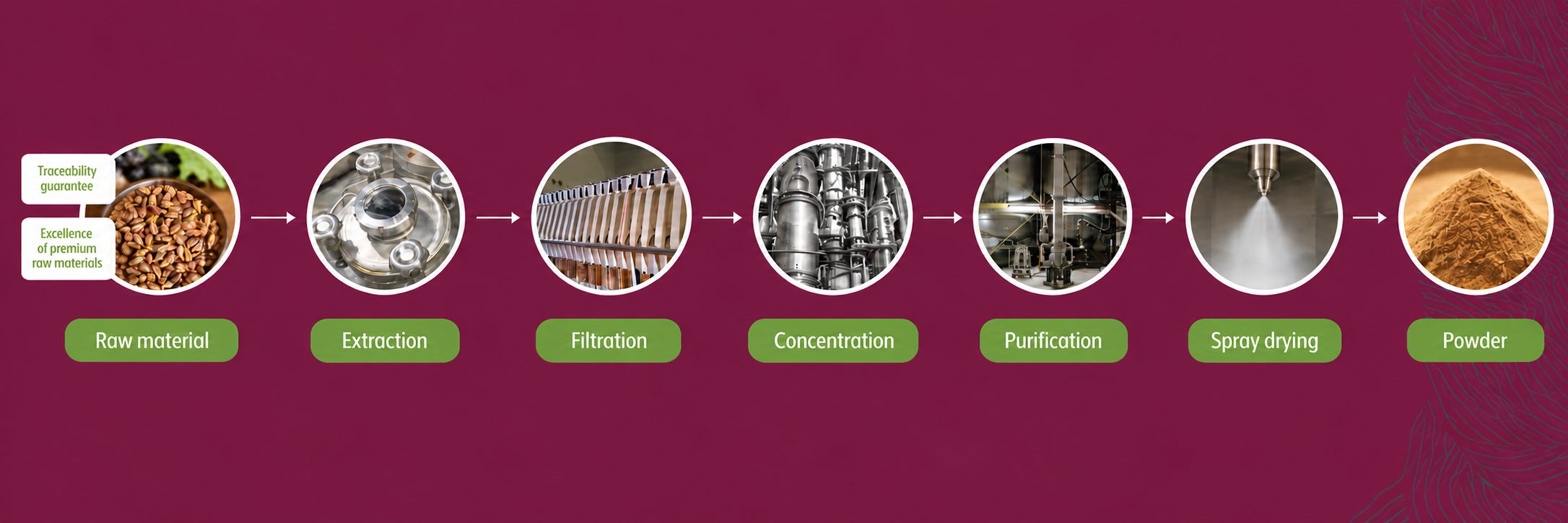
The production of OPSeed75 relies on a manufacturing process combining several stages designed to preserve polyphenolic compounds throughout processing:
- Raw material sourcing: grape seeds
- Solid-liquid extraction
The grape seeds are brought into contact with a suitable liquid solvent in order to extract the target compounds present in the plant material and transfer them into a liquid phase - Filtration and solid separation
Following extraction, the liquid phase containing the extracted compounds is separated from the solid residues of the raw material through filtration. - Concentration of the liquid extract
The liquid extract is then concentrated by evaporation to increase the concentration of the compounds of interest. - Liquid-liquid purification
The extract is brought into contact with another liquid phase. This step makes it possible to separate the different compounds present in the extract and select the desired fraction. - Spray drying
The purified extract is dried by atomisation into fine droplets within a stream of hot air. - Finished product
At the end of the process, the extract is obtained in powder form.
OPSeed75: a 100% natural solution for crop protection
Derived from the extraction of Vitis vinifera L. grape seeds, OPSeed75 contains more than 75% oligomeric proanthocyanidins (OPCs). It is supplied as a highly dispersible wettable powder.
Since January 2025, Vitis vinifera L. erape seed extract has been approved at European level as a basic substance for plant protection, in accordance with Commission Implementing Regulation (EU) 2025/96 of 21 January 2025.
This regulatory recognition is part of the ongoing evolution of European crop protection strategies aimed at diversifying available solutions and developing alternatives to conventional plant protection products. The French Ministry of Agriculture also highlights the importance of research and the development of alternative solutions within the framework of the Ecophyto 2030 strategy and the Strategic Action Plan for Anticipating the Withdrawal of Active Substances and Developing Alternatives PARSADA.
Efficacy against several crop diseases
OPSeed75 has been evaluated for use on several crops, including:
- Vineyards, against downy mildew caused by Plasmopara viticola,
- Apple trees, against apple scab caused by Venturia inaequalis,
- Potatoes, against late blight caused by Phytophthora infestans,
- Lettuce downy mildew caused by Bremia lactucae.
This diversity of applications, combined with its multisite mode of action, allows OPSeed75 to be integrated into different crop protection strategies depending on the target disease, crop and conditions of use.
Compatibility with conventional treatment programmes
One of the advantages of OPSeed75 lies in its ability to be integrated into existing crop protection programmes. The product may be used alone or mixed with other active substances.
This approach aligns with the principles of integrated crop protection, which combine different prevention and protection methods according to the level of risk and crop characteristics.
Research conducted by INRAE (the French National Research Institute for Agriculture, Food and Environment), including the article ‘Can organic farming manage without copper?’, together with work from several technical organisations, is part of this broader effort to diversify the solutions available for crop protection.
OPSeed75 can contribute to diversifying the solutions implemented within crop protection programmes and can be integrated into strategies designed to optimise the use of different protection methods, particularly in crops where copper has historically played a major role.
In its roadmap entitled ‘Feuille de route pour la diminution de l’utilisation du cuivre en agriculture’ (‘Roadmap for reducing the use of copper in agriculture’), the French Ministry of Agriculture and Food Sovereignty highlights several key levers for reducing copper use, including biocontrol solutions, resistant varieties, inoculum reduction strategies, decision-support tools, and improved spray application quality.
Before any tank mixing, it is recommended to carry out a prior physico-chemical compatibility test under the intended conditions of use.
Best practices for use
The effectiveness of a crop protection solution depends not only on product quality, but also on preparation quality, application timing and application conditions.
Spray mixture preparation: the importance of pre-dilution
A homogeneous pre-dilution of OPSeed75 is recommended before incorporation into the spray tank.
Depending on the prepared volumes and the equipment available on the farm, several methods may be used:
- For large volumes, carry out a pre-dilution in a bucket or suitable container using a mechanical mixer, such as a paint mixer,
- In the absence of mechanical equipment, gradually incorporate water into the powder while mixing manually,
- For smaller volumes, prepare the pre-dilution in a sealed container and shake before incorporation into the spray tank,
- Farms with access to hot water in the plant protection preparation area may carry out the pre-dilution using warm water in order to facilitate powder dissolution.
It is recommended to partially fill the spray tank with clean water before adding the pre-diluted preparation, then incorporate it progressively under agitation. Continuous agitation during preparation and application helps maintain a homogeneous spray mixture.
The key point is to avoid adding the entire quantity of OPSeed75 powder directly into the final water volume. Gradually adding water to the powder under agitation helps obtain a homogeneous preparation and facilitates implementation under field conditions.
Application conditions
Applications should be carried out under favourable conditions in order to achieve homogeneous crop coverage and suitable positioning according to disease pressure.
It is recommended to:
- Apply preventively or at the earliest stages of disease risk development,
- Take weather conditions into account,
- Avoid applications under unfavourable conditions, particularly during high temperatures or strong winds,
- Ensure uniform vegetation coverage,
- Follow crop-specific recommendations for use,
- Regularly monitor crops in order to adapt interventions according to changes in disease pressure.
This approach is fully aligned with the principles of integrated pest management, which prioritise prevention and the combination of different protection methods.
For apple scab, for example, monitoring climatic conditions, managing inoculum and adapting the crop protection programme are all important levers. These different factors are detailed in the article dedicated to apple scab management.
The integration of OPSeed75 into crop protection programmes must be considered according to the crop, disease pressure and conditions of use.
OPSeed75 and the evolution of crop protection strategies
OPSeed75 fits within the current evolution of crop protection strategies, which rely on the diversification of available solutions and the combination of several agronomic and technical levers. Derived from Vitis vinifera L. grape seeds and rich in oligomeric proanthocyanidins (OPCs), it is a plant-based solution that can be integrated into different crop protection programmes depending on the crop and target disease.
Its integration into crop protection strategies relies on a reasoned approach, taking into account the crop, disease pressure, intervention timing and application conditions. This approach contributes to diversifying the solutions available for crop protection.