Primary inoculum: how to limit apple scab development?

Management of the primary inoculum in apple orchards is now recognised as one of the most effective strategies for controlling apple scab, a major fungal disease caused by Venturia inaequalis. By reducing, from late winter onwards, the quantity of ascospores* present in fallen leaves on the orchard floor, growers can significantly decrease the risk of primary infections in spring, when young tissues are most susceptible.
In the context of the transition towards more sustainable orchard systems with reduced reliance on conventional plant protection products, early inoculum management represents a strategic approach to safeguarding both fruit quality and orchard profitability.
*Ascospores: sexual spores produced by the fungus within pseudothecia that develop on infected fallen leaves.
According to INRAE (Diseases of Perennial Crops, 2021), “the control of primary infections determines the severity of the secondary disease cycle and the extent of apple scab epidemics.” This observation, widely confirmed by CTIFL* and the French Chambers of Agriculture, places primary inoculum management at the heart of integrated disease management strategies.
*CTIFL (Centre Technique Interprofessionnel des Fruits et Légumes): the French technical institute for applied research, experimentation and knowledge transfer in fruit and vegetable production.
Understanding primary inoculum to improve its control
What is primary inoculum?
Primary inoculum refers to the initial source of infectious spores present in the orchard at the end of winter. In the case of Venturia inaequalis, this inoculum consists of ascospores produced in infected leaves that have fallen to the orchard soil during autumn.
The primary infection cycle: a short but critical period
Ascospore maturation and release
During winter, Venturia inaequalis develops pseudothecia within fallen leaves. In spring, when environmental conditions become favourable (rainfall, temperature and humidity), the ascospores complete their maturation, marking the onset of primary apple scab infections.
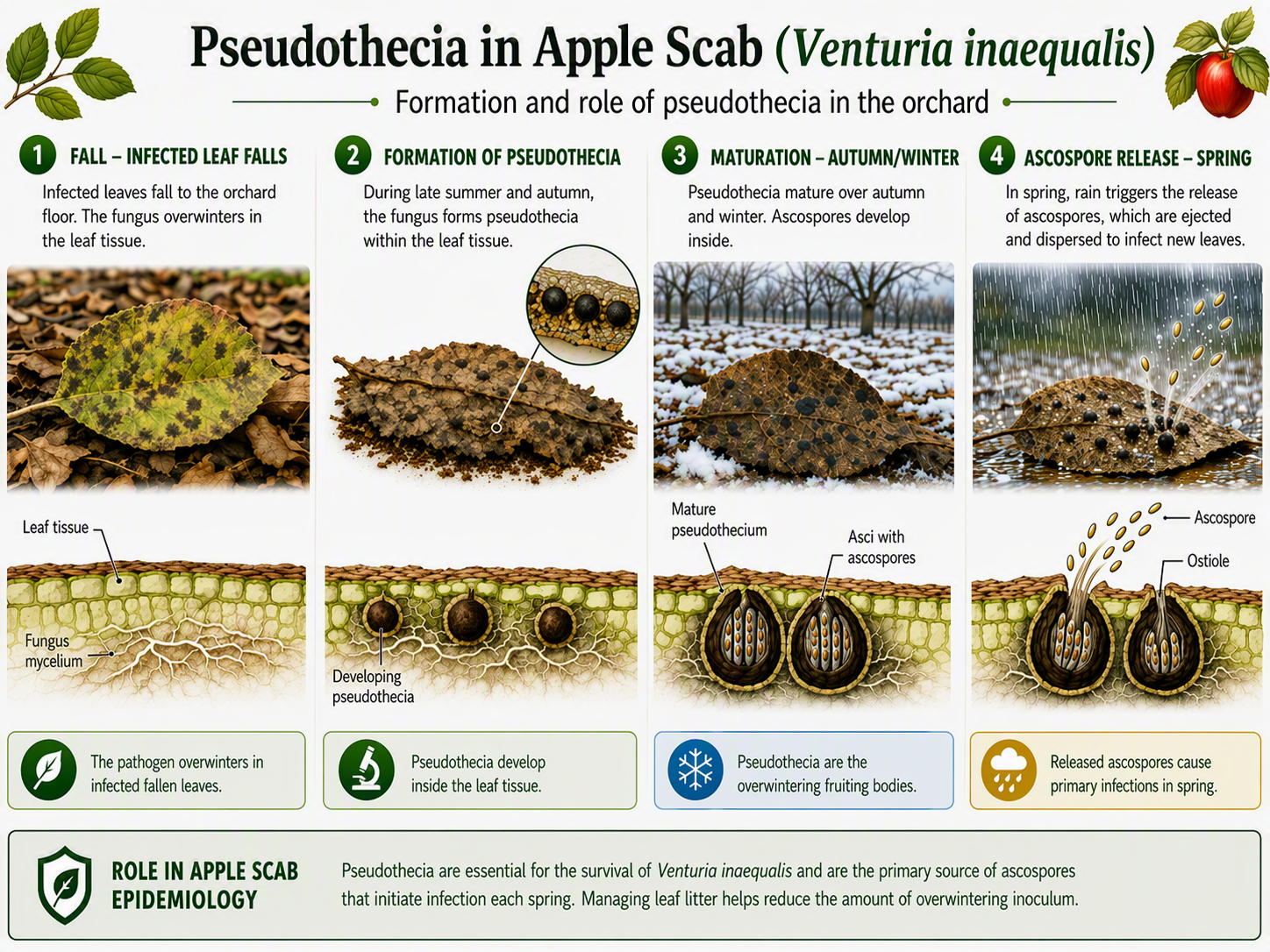
The fundamental principles of the Mills Model* (Mills & Laplante, 1940s), still incorporated into many DSSs (Decision Support Systems), indicate that infection requires:
- Rainfall triggering ascospore discharge and dispersal,
- A sufficiently long leaf wetness period (ranging from 6 to 28 hours depending on temperature),
- Young plant organs: expanding leaves, tender tissues and young fruit..
*Mills Model: A historical epidemiological model used to assess apple scab infection risk based on the interaction between leaf wetness duration and temperature.
According to CTIFL, “the majority of primary infections occur between the green tip stage and the beginning of flowering” (Arboriculture Review, 2021).
Why are primary infections so critical?
Primary infections drive the epidemic dynamics of apple scab throughout the remainder of the growing season:
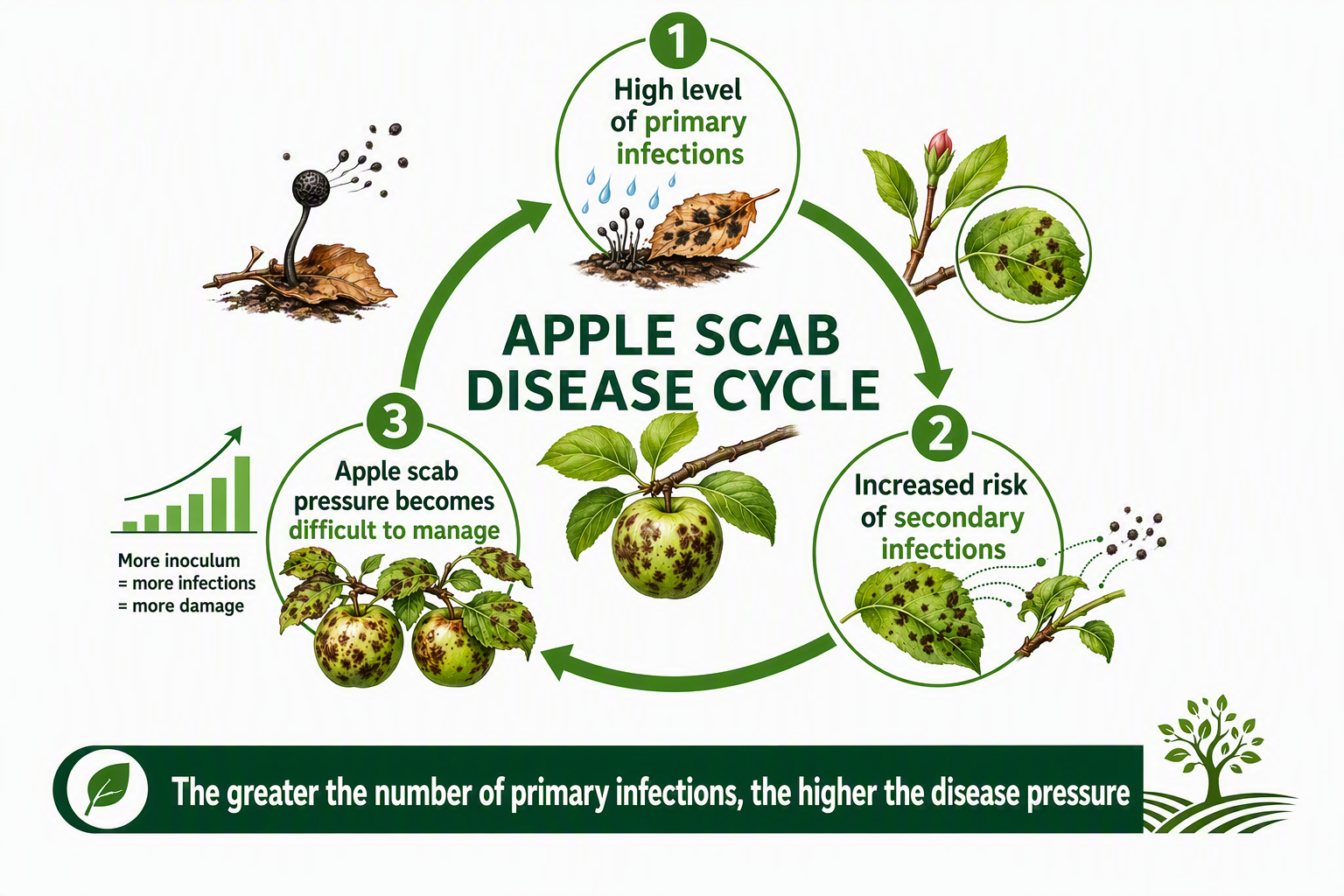
According to IFPC trials*, inadequate management of the primary infection cycle may result in a substantial increase in fruit downgrading at harvest and during post-harvest grading, with losses reaching several tens of percent in high-pressure years.
*IFPC (Institut Français des Productions Cidricoles): the French technical institute dedicated to cider fruit production, orchard management and fruit quality.
Reducing primary inoculum: recommended technical strategies
French technical organizations, including IFPC, the Chambers of Agriculture and CTIFL, recommend an integrated approach combining cultural practices, monitoring and preventive interventions.
1. Mechanical and cultural practices: targeting the source of inoculum
Several techniques can be implemented to reduce the inoculum present in fallen leaves:
- Leaf Shredding
According to ANPP (Association Nationale Pommes et Poires – National Apple and Pear Association), leaf shredding can significantly reduce inoculum levels, decreasing the ascospore release potential by up to 90–95% in spring.
- Soil Management and cover crop practices
Managing leaf litter through incorporation into the soil, removal from the orchard floor, or acceleration of its decomposition, combined with appropriate cover crop management and the application of mature compost, helps limit pseudothecia development.
- Canopy aeration through pruning
Improving air circulation within the orchard canopy reduces leaf wetness duration and consequently limits conditions favourable for infection events.
- Cultivar Selection
The use of cultivars with lower susceptibility to apple scab represents an effective prophylactic measure, particularly in areas subject to high disease pressure or within low-input production systems.
These practices are relatively easy to implement at orchard scale and constitute a first essential step towards achieving a sustainable reduction in apple scab pressure.
2. Monitoring risk with Decision Support Systems (DSSs)
Decision Support Systems have become essential tools in integrated crop protection. They help growers to:
- Simulate infection risk based on rainfall events and weather conditions,
- Anticipate peaks in ascospore release,
- Optimise the timing of preventive interventions.
Examples of DSSs:
- RIMpro: An epidemiological forecasting model used to anticipate apple scab pressure. It is one of the most widely used DSSs in fruit production, both in France and across Europe.
- Agrometeo / Sopra / Aires-Météo : Regional agricultural weather station networks providing data on rainfall, leaf wetness and temperature to support disease forecasting models for apple scab, powdery mildew and other diseases.
3. Pre-bloom treatments: securing control of primary infections
The pre-bloom period is a strategic stage in orchard disease management. It coincides with:
- High levels of ascospore release,
- High susceptibility of young tissues to infection,
- A critical period for early inoculum management and for maximising the effectiveness of the overall protection programme.
The objective is not to increase the number of treatments, but rather to position them accurately using DSSs to target risk periods and intervene at the most appropriate time.
A context of reduced availability of conventional fungicide solutions
Apple scab management is evolving in a context marked by the gradual reduction in available active substances, increasingly stringent regulatory requirements and the emergence of resistance in Venturia inaequalis populations. As a result, protection strategies are increasingly based on an integrated approach combining prophylactic measures, Decision Support Systems, optimised treatment timing and complementary solutions such as basic substances. This diversification helps preserve the effectiveness of protection programmes while reducing dependence on conventional fungicides.
Basic substances: a complementary tool within an Integrated Pest Management (IPM) strategy
Basic substances approved at European level represent a complementary tool that can be incorporated into IPM strategies. Their use is primarily preventive, supporting cultural practices or complementing authorised plant protection products.
From a regulatory perspective, they fall under the “basic substance” category established by Regulation (EC) No 1107/2009. Their use is authorised following European approval and is subject to strictly defined conditions.
Research conducted by INRAE in integrated crop protection indicates that these substances can be incorporated into disease management programmes to diversify modes of action, strengthen preventive strategies and, where efficacy has been demonstrated, reduce reliance on conventional active substances.
OPSeed75: a grape seed-derived solution to strengthen preventive apple scab management
OPSeed75 , a 100% naturally derived solution developed by Groupe Berkem, is a grape seed extract (Vitis vinifera L.) rich in polyphenols and recognised as a basic substance by the European Union (Article 23 of Regulation (EC) No 1107/2009). It can be integrated among the tools ahttps://www.groupeberkem.com/vailable within agroecological and low-input production systems, in line with current developments within the fruit sector.
Agronomic value in primary inoculum management
To support the reduction of conventional chemical inputs, OPSeed75 fits within a preventive approach and offers several benefits during the early stages of the disease cycle:
- Pre-bloom application, when young tissues are most susceptible and when most primary infections occur,
- Continuity within the protection programme by complementing key treatments and maintaining a consistent level of protection,
- Application during periods between major infection-risk events,
- Diversification of control measures, helping to reduce selection pressure on conventional active substances.
Why is pre-bloom positioning relevant?
Between the green tip and pink bud stages:
- Developing tissues are highly susceptible to infection,*
- The first mature ascospores begin to be released,
- Most primary infections are initiated during this period,
- Humid conditions (rainfall, dew and leaf wetness periods) favour pathogen germination and penetration.
In this context, OPSeed75 can be positioned as a supplementary treatment during the first levels of infection risk, or as part of a programme aimed at reducing inoculum potential as early as possible.
Assessing the effectiveness of optimal inoculum management
The impact of effective primary cycle management can be assessed using both technical and economic indicators.
Technical indicators:
- Reduced number of primary lesions,
- Reduced secondary infections,
- Improved effectiveness of preventive applications,
- Reduced reliance on curative treatments and lower chemical Treatment Frequency Index (TFI).
Economic indicators:
- Reduced fruit downgrading at the packing station,
- Improved yield stability,
- Reduced operating costs,
- Enhanced marketable fruit quality.
Trials conducted by IFPC and SudExpé* show that effective management of the primary infection cycle is directly associated with improved harvest quality and a significant reduction in overall apple scab pressure.
* SudExpé: Experimental station within the CTIFL network specialising in fruit production.
Summary: a multi-lever strategy to reduce apple scab risk
Effective risk management relies on a structured combination of complementary measures, each acting at a key stage of the pathogen’s life cycle. Technical recommendations converge towards a sequential organisation of interventions:
- Cultural practices: reducing the ascospore reservoir,
- Decision Support Systems: anticipating critical infection periods,
- Preventive use of OPSeed75: strengthening and diversifying control measures.
This multi-lever strategy enables a sustainable reduction in apple scab pressure while safeguarding fruit quality and commercial value in a context of increasing restrictions on the use of conventional curative products.
AI-assisted visuals